
How to Choose the Best Filter Units in 2026?

Choosing the right Filter Units in 2026 is not a matter of buying the highest-rated filter. It means matching the unit to the room, pollutant, airflow, and maintenance budget. A filter that looks impressive on a specification sheet can still disappoint if the fan cannot push air through it. Small details matter: room size, duct dimensions, operating hours, and how often staff can replace filters.

The U.S. Environmental Protection Agency’s Guide to Air Cleaners in the Home reports that HEPA filters are designed to capture at least 99.97% of particles measuring 0.3 microns. That benchmark is useful, but it does not guarantee whole-room performance. The EPA also points readers toward clean air delivery rate when comparing portable units. For HVAC applications, ASHRAE Standard 52.2 provides a recognized method for testing and rating particle-filter performance. These measures answer different questions. Neither replaces checking system compatibility.

Indoor-air researcher Dr. Richard Corsi has helped bring practical filtration choices into public discussion. A careful paraphrase of his guidance is: “Match filtration to the pollutant, the space, and the airflow the system can sustain.” It is a sound principle, not a magic formula. Real rooms leak air, filters load with dust, and operating costs can change a buying decision. Some selection guides understate these everyday limits. This guide will compare filter types, ratings, pressure drop, service needs, and use cases, so buyers can judge what fits their actual conditions—not just the label.
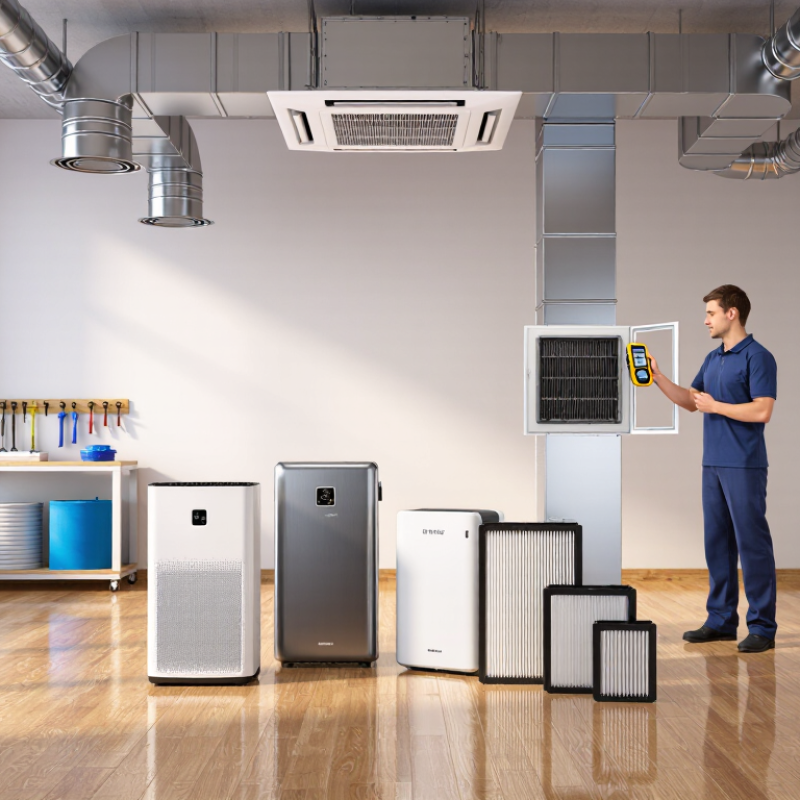
How to Choose the Best Filter Units in 2026?

Understanding Filter Units and Their Role in 2026

A filter unit draws air through a medium that captures selected particles or gases, then returns treated air to the room or system. Its real-world performance depends on airflow, filter fit, operating time, and maintenance—not just the filter label. The World Health Organization’s 2022 air-quality update estimated that 99% of the global population lived in places where its air-quality guideline levels were not met in 2019. That figure describes outdoor exposure, not the share of people who need a particular device. Still, it shows why indoor air deserves careful attention. The U.S. Environmental Protection Agency notes that concentrations of some indoor pollutants are often two to five times outdoor levels. A clean-looking grille proves little.

Match the unit to the pollutant and room. For airborne particles, compare clean-air delivery rate with room size and check that replacement filters are readily available. ASHRAE Standard 52.2 rates particle-filter efficiency by particle size; it does not measure removal of gases or prove how a unit performs in every installation. Activated-carbon media may reduce some gases, but capacity and service life vary. Check airflow at the actual fan setting, noise near a sleeping area, and whether air can circulate around furniture. A neglected filter can restrict airflow. That detail is easy to miss. Source control and ventilation still matter, since filtration alone cannot address every indoor pollutant.

How to Choose the Best Filter Units in 2026

Compare the ePM1 efficiency thresholds shown for selected ISO 16890 filter classes. A higher threshold indicates a higher minimum efficiency for the ePM1 classification. Check the filter’s test data and your system’s airflow and pressure-drop requirements before choosing: efficiency alone does not determine whether a filter is suitable.

Defining Your Filtration Needs and Operating Conditions

Choosing a filter unit starts with the contaminant, not the catalogue. Identify whether the target is dust, smoke, mist, or another particle type, then estimate its size and concentration. Record peak loads, not just daily averages. A brief production surge can clog a filter sooner than expected. Note the required airflow, available space, and acceptable pressure drop.

Operating conditions matter just as much. Check temperature, humidity, moisture, and whether particles are sticky or abrasive. The World Health Organization’s 2021 air quality guidelines set annual PM2.5 at 5 µg/m³ and the 24-hour level at 15 µg/m³. These are ambient-air benchmarks, not equipment-sizing rules, but they help clarify the quality target. For room-scale applications, the US EPA’s Guide to Air Cleaners in the Home recommends a smoke CADR of at least two-thirds of the room’s floor area in square feet, assuming an eight-foot ceiling. Industrial systems need calculations based on airflow and contaminant loading instead.

Small details matter. Compare clean and loaded pressure drop, service access, and replacement frequency. Measure, then verify. A unit may meet its efficiency target on paper yet underperform when airflow rises or dust composition changes. I would treat initial estimates as provisional and confirm them with site measurements or a controlled trial.

Comparing Filter Types, Media, and Performance Ratings

How to Choose the Best Filter Units in 2026?

Comparing Filter Types, Media, and Performance Ratings

In 2026, match filter media to the pollutant, then check its rating against room airflow. Pleated mechanical filters capture particles; activated carbon adsorbs some gases and odors. Carbon performance depends on media mass and contact time. One layer rarely solves every problem.

Ratings are not interchangeable. ASHRAE Standard 52.2 uses particle-removal measurements across three size ranges to assign MERV ratings. ISO 16890 reports ePM1, ePM2.5, and ePM10 efficiencies. The U.S. EPA’s 2023 Guide to Air Cleaners in the Home describes HEPA filters as removing at least 99.97% of particles at 0.3 microns. AHAM sizing guidance recommends a smoke CADR of at least two-thirds of the room’s floor area, assuming an eight-foot ceiling. Check the tested CADR, not just a large-looking MERV number.

Look beyond capture claims. A dense filter can increase pressure drop and reduce airflow, especially in an undersized unit. Check tested airflow, noise, and replacement intervals. Carbon media may need frequent replacement in kitchens or smoky rooms. Placement and maintenance also affect real-world performance. One comparison remains imperfect: ratings come from controlled tests, not your leaky room or dusty hallway. The labels make this less obvious than it should be.

Assessing Compliance, Maintenance, and Total Ownership Costs

Compliance starts with the conditions the unit will actually face, not a brochure’s ideal test setup. Check whether documented performance matches your airflow, particle load, temperature, and humidity. Ask for current test data, compatible filter specifications, and clear change-out criteria. Then compare these details with the standards and site requirements that apply to your facility. A qualified specialist can help interpret gaps. Paperwork matters. Keep installation records and inspection results together, so a maintenance team can trace decisions later.

Ownership costs extend well beyond the purchase price. Include replacement filters, labor, energy use, disposal, and any production downtime during servicing. Pressure drop deserves attention: a filter that loads quickly may increase fan energy or require frequent changes. Ask suppliers for service intervals under conditions similar to yours, rather than relying on best-case estimates. Small details matter. A few minutes of access difficulty can become a recurring labor cost. Still, a spreadsheet can make a weak estimate look precise. Record assumptions, compare realistic operating scenarios, and revisit them after the first months of use. These estimates are rarely perfect, but honest uncertainty is more useful than false precision.

How to Choose the Best Filter Units in 2026? — Assessing Compliance, Maintenance, and Total Ownership Costs
Filter unit type Typical application Compliance and verification Maintenance considerations Total ownership cost considerations Best suited for / key limitations
HVAC particulate filter
Panel, pleated, or bag-style media
General ventilation and air-conditioning systems; captures airborne particles in occupied or process spaces. For many general-ventilation filters, ISO 16890 classifies performance by ePM particulate fractions. In the United States, ASHRAE 52.2 reports MERV ratings. These rating systems use different methods and should not be treated as direct equivalents. Inspect and replace according to the system’s pressure-drop limit, site conditions, and manufacturer guidance. Check for bypass, damaged media, and correct fit during replacement. Compare purchase price with pressure drop at the required airflow, fan energy, replacement frequency, labor, and disposal. A lower-cost filter may cost more over time if it loads quickly or creates excessive resistance. Suitable for building and general process ventilation. Not a substitute for a certified HEPA filter where high-efficiency particulate control is specifically required.
Cartridge dust collector
Pulse-cleaned collector
Dry dust from applications such as metalworking, woodworking, and powder handling, subject to suitable dust and collector design. There is no single efficiency rating that establishes suitability for every dust or workplace. Verify performance for the actual process, applicable exposure and emissions requirements, and any combustible-dust obligations. Monitor differential pressure and pulse-cleaning operation. Inspect cartridges, seals, compressed-air supply, hopper discharge, and dust accumulation. Cleaning settings and cartridge life depend on dust characteristics and operating conditions. Include cartridges, compressed air, fan electricity, disposal, labor, and any required downstream treatment. Fine, sticky, abrasive, or high-moisture dust can increase cleaning demand and shorten media life. Often useful where compact equipment and fine-dust collection are priorities. Confirm that the media and collector are appropriate for the dust; combustible-dust hazards require a separate engineering assessment.
Fabric baghouse
Pulse-jet, shaker, or reverse-air design
Large-volume industrial dust collection, including many bulk-material and process applications. Confirm the applicable emissions limits, test method, and permit conditions for the site. Performance depends on fabric selection, air-to-cloth ratio, cleaning, sealing, and operating conditions; a generic filter rating alone does not establish compliance. Inspect bags, cages, tube sheets, cleaning equipment, hopper discharge, and differential pressure. Plan for bag changes and safe access; moisture, temperature, and dust chemistry influence fabric selection and service life. Consider equipment footprint, fan power, cleaning-system energy, bag replacement, downtime, dust handling, and maintenance access. For large flows, compare lifecycle costs at the required operating point rather than purchase price alone. Can suit high dust loads and large airflow duties. Requires space and a well-designed dust-discharge system; verify temperature, humidity, chemical compatibility, and dust-safety requirements.
HEPA filter unit
High-efficiency particulate air filtration
Applications requiring high-efficiency removal of airborne particles, such as clean spaces, containment systems, or selected healthcare and industrial uses. HEPA classifications are defined under standards such as EN 1822 and ISO 29463. Under EN 1822, an H13 filter has an overall efficiency of at least 99.95% at the most penetrating particle size, and H14 at least 99.995%. Confirm the required class and installed-system leak-test method for the application. Track pressure drop and airflow; replace using controlled procedures that prevent release or cross-contamination. Verify seals, housing integrity, and installation after filter changes where the application requires it. Account for higher-efficiency media and housings, fan energy at the actual operating point, integrity testing, specialist labor, and controlled disposal where needed. The lowest initial price may not minimize lifecycle cost. Appropriate when the required particle-control level justifies HEPA filtration. Correct housing, sealing, installation, and verification are essential; the filter’s classification alone does not prove system performance.
Activated-carbon adsorber
Gas- and odor-control unit
Reduction of selected gaseous contaminants or odors using an adsorbent chosen for the target compounds. Particle-filter ratings such as MERV or ISO 16890 do not demonstrate gas-phase removal. Specify target compounds and required outlet limits, then verify performance with suitable sampling or monitoring. Track service life and breakthrough using a method appropriate to the contaminant. Replace or regenerate media as designed; control humidity and upstream particulate loading because both can affect performance. Include adsorbent quantity and replacement or regeneration, pressure drop, monitoring, media handling, and disposal. Cost depends strongly on contaminant concentration, airflow, humidity, and required removal. Useful for selected vapors and odors when the adsorbent is compatible with the target compounds. It does not replace particulate filtration and is not universal protection against all gases.
Selection note Before comparing quotations, define airflow, contaminant type and loading, required outlet performance, operating hours, temperature and humidity, available space, and local regulatory requirements. Compare lifecycle cost using the same design airflow and operating assumptions; include energy, consumables, testing, labor, downtime, and disposal. Classifications and compliance obligations depend on the application, jurisdiction, and current standard editions.

Verifying the Best Filter Unit for Your Application

How to Choose the Best Filter Units in 2026?

Verifying the Best Filter Unit for Your Application

A filter unit is only “best” when it suits the actual process. Start by identifying the contaminant, its particle size, and the required outlet quality. Then check flow rate, operating temperature, moisture, and pressure limits. These details matter. A unit rated for clean, steady airflow may struggle with damp dust or frequent flow changes. Review test data and confirm how performance was measured; a specification without test conditions tells only part of the story.

Tips: Match the filter media to the substance being captured, and check chemical compatibility. Ask how pressure drop changes as the filter loads. Confirm replacement parts are available and that maintenance can be done safely in the installation space. If possible, test a sample or pilot unit under representative operating conditions. Record inlet and outlet readings, flow, and pressure drop. Small changes can reveal a poor fit early.

Do not rely on the lowest initial price or a single efficiency figure. Compare expected service life, energy use, cleaning needs, and disposal requirements. I would also revisit the choice after installation; real operating conditions can expose assumptions that looked reasonable on paper. That is not a perfect process, but careful measurement makes the decision more reliable.

Article Source:

Contact Us

Feel free to contact us anytime for questions, support, or assistance. We're here to help you with any inquiries you have.

  • Address: 10220 S. Dolfield Rd Suite 110
    Owings Mills, MD, 21117
  • Email: sale@oshanbeauty.com
  • Call Us: (410) 356-0000
  • Working hours:

    Monday – Friday: 9am – 5pm
    Saturday and Sunday: Closed

Latest Posts

Laser Hair Removal Maryland: 10 Common Myths Debunked by Experts

What if the repetitive cycle of razor burn and painful ingrown hairs wasn't a...
Read More

Body Sculpting in Owings Mills: A Medical Guide to Non-Surgical Contouring

What if you could finally address those persistent areas of fat without a single...
Read More

Laser Skin Rejuvenation in Owings Mills: Your Guide to a Radiant Complexion

Your skin is a living organ, not a canvas for trial and error. If...
Read More

GentleCure: Non-Surgical Skin Cancer Treatment in Maryland

What if you could eliminate your skin cancer with the same precision as surgery,...
Read More

ARTAS Robotic Hair Transplant: What to Expect

Are you struggling with hair loss and the self-consciousness that often comes with it?...
Read More
Call Us Appointments

Accessibility Tools

Increase TextIncrease Text
Decrease TextDecrease Text
GrayscaleGrayscale
Invert Colors
Readable FontReadable Font
Reset