7 Tips for Buying Self Adhesive Bandages in Bulk?
Buying Self Adhesive Bandage products in bulk can simplify restocking for clinics, sports programs, first-aid suppliers, and workplaces. Yet a low unit price is only useful when the rolls perform consistently and suit the people using them. A carton may look like a bargain beside a desk, but poor adhesion, awkward widths, or unclear labeling can create daily frustration. Details matter.
This guide introduces seven practical checks for comparing suppliers and products before placing a larger order. It covers material and stretch, sizing, adhesive performance, packaging, shelf life, supplier documentation, and total cost. Check product descriptions against samples and written specifications whenever possible. A bandage that stays in place during light movement may behave differently on damp skin or under repeated motion. Not every listing explains those limits clearly. Ask direct questions.
Bulk purchasing also calls for sensible inventory planning. Estimate monthly use, storage conditions, and the sizes your team actually needs. Check recommended-use information, carton quantities, and replacement policies before committing. For healthcare settings, follow local clinical procedures and consult qualified professionals when choosing products for patient care. This article is a purchasing guide, not medical advice. Some details are easy to miss on a product page, so double-check them rather than assume. The aim is a dependable supply, less waste, and fewer surprises when the next box is opened. Depending on your setting, the cheapest option may not offer the best value.
Identify the Intended Uses and Required Bandage Types
Before ordering in bulk, define the wound and the setting. Small cuts on fingers need narrow, flexible adhesive strips; broad scrapes need larger sterile pads with skin-friendly adhesive. For joints, fabric-backed dressings usually move better than stiff plastic. For securing gauze, cohesive wrap adheres to itself rather than skin, so it serves a different purpose. They are not interchangeable.
Match the type to users, too. Sweat, frequent handwashing, sensitive skin, and latex allergies can change what stays comfortable and in place. Keep sterile dressings for open wounds, and don’t treat deep, infected, or slow-healing wounds as routine first-aid cases.
CDC’s National Diabetes Statistics Report (2024) estimates that 38.4 million people in the United States have diabetes. That figure is a reminder to distinguish everyday minor-injury supplies from products selected under clinical guidance for higher-risk wounds. More stock is not always better.
Estimate quantities from actual use by location: a workshop may need durable finger strips, while a kitchen may use more water-resistant dressings. Check sizes against the injuries staff commonly report, not just the cheapest case price. A spreadsheet can miss uncomfortable edges or adhesive that fails after washing. Test a small assortment first. Then review usage and skin reactions before committing to a larger order.
Compare Materials, Sizes, Stretch, and Breathability
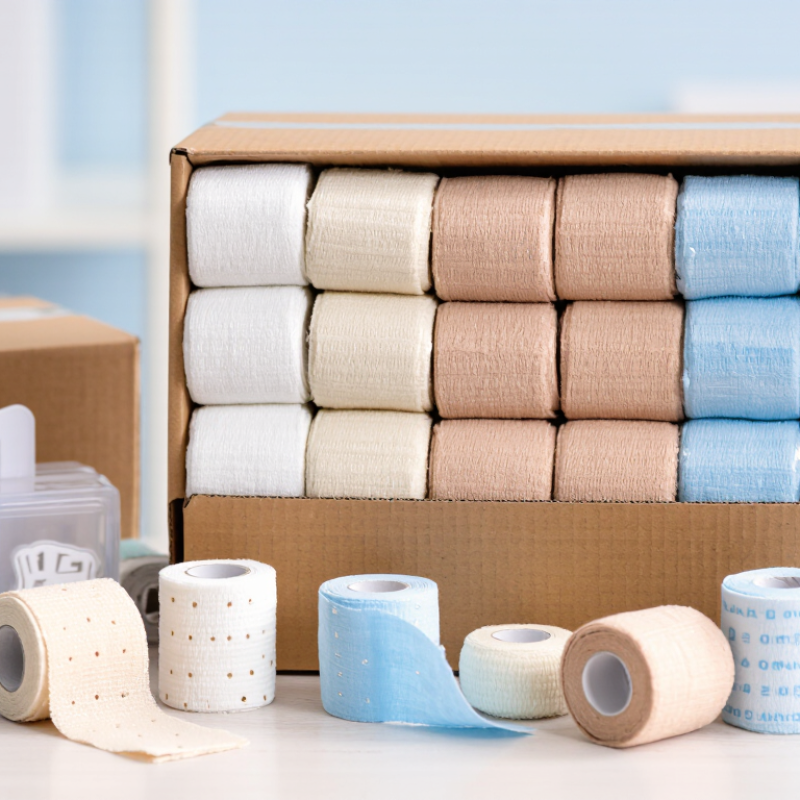
When buying self-adhesive bandages in bulk, compare the fiber and backing, not just the package price. Nonwoven wraps often feel soft and conform easily; elastic woven options may feel firmer and resist tearing during repeated handling. Check the label for latex content and confirm whether the wrap adheres to itself rather than skin. Small detail, big difference. A 1-inch roll can suit fingers, while 2- to 4-inch widths cover limbs faster. Keep more than one size in stock if staff treat varied injuries.
Stretch and airflow affect comfort and handling. A wrap that stretches smoothly can follow a wrist or ankle without bulky folds, but excessive tension may feel restrictive. Ask suppliers for elongation and air-permeability test results, rather than relying on “breathable” alone. ASTM D4964-96(2020) describes a standardized method for measuring elastic-fabric tension and elongation; ASTM D737-18(2023) provides a method for testing fabric air permeability. These methods make product comparisons more consistent, though results can differ by material and construction. Check the stated test conditions. I still wouldn’t choose from figures alone: try a sample on a curved joint, then inspect whether edges roll or the wrap loosens after movement.
7 Tips for Buying Self-Adhesive Bandages in Bulk
Compare materials, sizes, stretch, and breathability before choosing a bulk pack.
Common nominal widths include 1, 2, 3, and 4 inches (2.54, 5.08, 7.62, and 10.16 cm). Availability varies by supplier. Match width to the intended area, then compare material, stretch, breathability, adhesion, skin sensitivity, roll count, and expiry information before ordering in bulk.
Check Adhesion, Skin Compatibility, and Removal Ease
Bulk pricing can hide differences in how self adhesive bandages perform. Request samples from the same product range before ordering cartons. Check that the bandage stays in place during ordinary movement without pulling uncomfortably. A loose edge after a few minutes may signal a poor fit for your intended use.
Test on clean, dry skin, following the supplier’s directions. Try a short wear period first, then check for redness, itching, or discomfort. People with sensitive or fragile skin may need extra care; ask a healthcare professional when unsure. They vary. Also note how removal feels after several hours. The bandage should peel away steadily, without painful tugging or heavy adhesive residue. Keep notes. Compare results across users, since skin and application habits differ. Before a large purchase, confirm that sample performance matches the bulk product and packaging. A small trial takes time, but skipping it can leave you with stock that is hard to use.
7 Tips for Buying Self-Adhesive Bandages in Bulk: Check Adhesion, Skin Compatibility, and Removal Ease | Tip | What to Check | Practical Buying Guidance |
| 1. Confirm the adhesion type | Check whether the bandage is cohesive, meaning it sticks to itself rather than directly to skin, hair, or clothing. | Review the product description and instructions. Test a sample for secure overlap without excessive tightness or slipping. |
| 2. Check skin compatibility | Review material and ingredient information, including any stated natural rubber latex content and relevant warnings. | If users have known sensitivities, confirm suitability with the manufacturer and consider a small trial before placing a large order. |
| 3. Assess removal ease | Check whether the wrap can be unwound or cut away as directed without pulling unnecessarily on skin or hair. | Try removal on a sample and follow the instructions. Do not assume that every cohesive wrap has identical tear or unwind performance. |
| 4. Match width and length to use | Compare available roll widths and lengths with the body areas and tasks for which the bandages will be used. | Choose a useful mix only if your storage and inventory process can manage multiple sizes; verify dimensions on the packaging. |
| 5. Inspect stretch and support | Look for clear instructions on application and stretching, and assess whether the material feels consistent when unrolled. | Sample the product before buying in quantity. Apply wraps evenly and avoid excessive tension, which can restrict circulation. |
| 6. Review packaging and shelf life | Check lot identification, package condition, storage instructions, and any expiration or use-by date provided. | Ask how bulk cartons are packed and shipped. Store stock according to the label and use older inventory first when appropriate. |
| 7. Compare total cost and documentation | Compare cost per roll, shipping, minimum order quantity, return terms, and the product specifications supplied by the seller. | Confirm that the product labeling and documentation meet the requirements that apply to your location and intended use. |
Verify Quality Standards, Packaging, and Shelf Life
When buying self-adhesive bandages in bulk, ask for current quality documents before comparing prices. Check that product specifications match the intended use, including width, stretch, and material details. Request test reports and lot numbers so shipments can be traced if a problem appears. Confirm that the supplier’s stated standards apply to the product, not just the factory. Paperwork can look convincing. Read it closely.
Tips: Inspect sample rolls and cartons before placing a large order. Look for consistent elasticity, clean edges, and adhesive that holds without leaving a sticky residue. Check that each roll is individually wrapped, seals are intact, and outer cartons protect against dust and dampness. Bulk buying can make one detail easy to miss: the inner box.
Shelf life deserves equal attention. Ask for manufacturing and expiry dates, plus the minimum remaining shelf life at delivery. Adhesive performance may be affected by heat, humidity, or poor storage, so confirm recommended storage conditions and keep cartons away from direct sunlight. Use a first-in, first-out system once stock arrives. I would not assume every shipment arrives with generous dating; verify the actual batch before accepting it. A quick check can prevent a costly surprise.
Evaluate Bulk Pricing, Supplier Reliability, and Storage Needs
Bulk pricing looks simple until freight, case quantities, and expiry dates enter the calculation. Compare the delivered cost per usable bandage, not just the carton price. Ask whether quotes include shipping and whether discounts require a much larger order. A low unit price can become costly if stock expires before use. Small detail, big difference.
Before committing, request a sample carton and check seal quality, adhesive hold, and ease of tearing. Confirm lot numbers, expiry dates, and realistic reorder lead times. Ask how damaged cartons or shortages are handled. Clear answers matter. A polished sales sheet is not proof of dependable supply; consistent records and responsive communication are stronger signs.
Plan storage before placing a large order. Keep cartons in a cool, dry area, away from direct sunlight and excess heat, and follow the product’s storage instructions. Store boxes off the floor and rotate older stock forward. Estimate monthly use and peak demand, but leave room for error. Forecasts are rarely perfect. If storage conditions or demand are uncertain, a smaller trial order may prevent wasted stock.