China Top Workwear Manufacturers for Global Buyers
Choosing reliable China workwear manufacturers can shape product quality, delivery stability, and buyer confidence. Global buyers need more than attractive prices. They need practical evidence from factory experience, production records, and consistent communication.
China’s manufacturing market includes large uniform producers, specialized protective clothing factories, and flexible workshops serving smaller orders. Their capabilities may include flame-resistant garments, high-visibility jackets, industrial coveralls, medical workwear, and durable corporate uniforms. Buyers should examine fabric composition, GSM weight, seam strength, zipper quality, colorfastness, and size consistency. A sample should be tested after washing, not only inspected when new.
Details matter. A reflective strip may look bright under showroom lights but fail after repeated cleaning. Thread tension can also affect comfort and durability around pockets, knees, and elbows. Reliable manufacturers should provide clear specifications, production photos, inspection procedures, and traceable documentation. Certifications must match the intended market and product claim. Independent testing may be appropriate when safety performance is important.
Communication reveals much.
A professional supplier answers precise questions without vague promises. They discuss minimum order quantities, sampling fees, lead times, packaging, labeling, and corrective actions openly. Factory audits and third-party inspections can reduce uncertainty, although they cannot replace careful buyer judgment. Not every established manufacturer is the right partner. Some smaller factories may offer better flexibility but need stronger quality controls. This is where evaluation becomes less perfect and more realistic. The goal is not to find a flawless supplier, but a dependable Workwear manufacturer with verified capability, transparent processes, and a willingness to improve.
What Defines a Top Chinese Workwear Manufacturer?
What Defines a Top Chinese Workwear Manufacturer?
A top Chinese workwear manufacturer proves performance beyond a polished catalogue. The factory should show documented fabric tests, stable sizing, and repeatable sewing quality. For safety garments, protection is not decorative. The International Labour Organization reported 2.93 million work-related deaths annually and about 395 million non-fatal injuries worldwide. This makes material selection and garment construction serious purchasing decisions.
During factory evaluation, inspect cutting rooms, seam lines, washing tests, and final inspection records. Ask how the supplier controls shrinkage after repeated laundering. Check whether reflective tape, flame-resistant fabric, or reinforced knees are tested by independent laboratories. The ISO Survey 2023 recorded more than 1.26 million ISO 9001 certificates worldwide, but certification alone cannot guarantee daily workmanship. A factory may pass an audit and still miss small defects during peak production. That uncomfortable gap deserves attention. Reliable manufacturers combine traceable production records, trained inspectors, realistic lead times, and clear corrective actions. They also explain limitations instead of promising everything.
Tips: Request a pre-production sample and wash it three times. Measure color change, seam strength, fit, and fabric shrinkage. Compare the sample with the approved specification. Ask for recent test reports, certificate scopes, and factory inspection evidence. A useful supplier should answer precisely, not quickly. Check packaging details too, especially size labels, carton counts, and moisture protection. These minor details often reveal how carefully the factory manages international orders.
How China’s Workwear Manufacturing Industry Is Organized
China’s workwear manufacturing industry is organized as a connected production network. Fabric mills supply cotton blends, polyester, aramid fibers, and recycled materials. Dyeing facilities then control color, shrinkage, and fabric performance. Trim suppliers produce zippers, buttons, reflective tape, labels, and protective accessories.
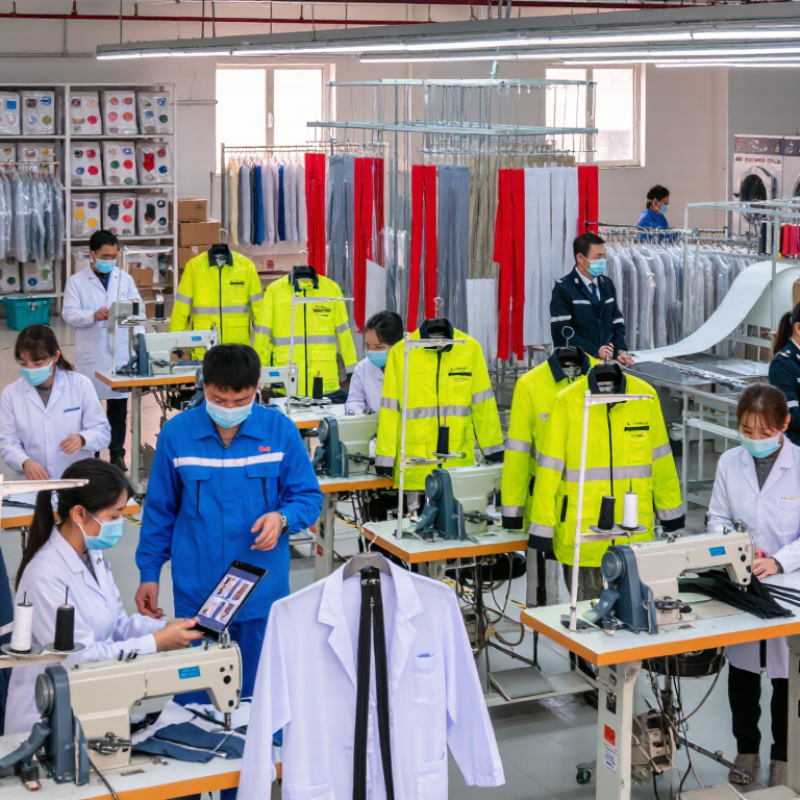
Garment factories usually specialize by product type or production scale. Some focus on uniforms, while others handle industrial jackets, coveralls, or high-visibility clothing. Larger factories may manage cutting, sewing, embroidery, pressing, and packing under one roof. Smaller factories often outsource fabric treatment or specialized stitching. This structure can improve flexibility, but it may also create quality gaps between suppliers.
Reliable buyers normally inspect the whole chain, not only the sewing floor. A practical review includes machine maintenance, worker training, fabric certificates, inspection records, and production capacity. Sample testing should measure seam strength, colorfastness, shrinkage, pocket alignment, and reflective-tape durability. Real production experience shows that a perfect sample does not always predict bulk consistency. That is uncomfortable, but important. Clear specifications, approved samples, and staged inspections reduce avoidable rework. Buyers should also confirm who controls dyeing and finishing, because these steps often influence delivery time and final performance. Careful documentation supports traceability when adjustments become necessary.
Key Product Categories for Global Workwear Buyers
China Top Workwear Manufacturers for Global Buyers
Key Product Categories for Global Workwear Buyers
Global buyers usually begin with coveralls, work jackets, and cargo trousers. These core products support construction, logistics, maintenance, and warehouse teams. Cotton blends offer comfort, while polyester blends often improve durability and color retention. Pocket placement matters more than many buyers expect. A deep phone pocket can reduce daily inconvenience.
High-visibility workwear is essential for road crews, transport workers, and night-shift teams. Buyers should check reflective tape width, placement, fabric weight, and washing performance. Flame-resistant garments require careful fabric selection and documented testing. They should never be treated like ordinary uniforms. Rainwear needs sealed seams, adjustable cuffs, and breathable panels. Otherwise, workers may feel protected but become uncomfortable within minutes.
Protective trousers and insulated jackets serve colder or more demanding environments. Medical and laboratory workwear may require lighter fabrics, clean finishes, and frequent-wash performance. Each category needs different sampling criteria. A common mistake is choosing fabric by price alone. The cheaper option may shrink, fade, or fail after repeated industrial washing. Better sourcing includes size charts, colorfastness checks, pre-production samples, and inspection records. Ask for current test documents, not old files. Supplier claims can sound complete, yet small details are sometimes missing. No manufacturer fits every project perfectly. Buyers should compare production capacity, communication speed, quality controls, and customization limits before placing a large order.
Quality, Compliance, and Customization Standards
China’s leading workwear manufacturers are judged by more than low prices. Quality begins with measurable controls: fabric weight, tear strength, seam performance, shrinkage, and colorfastness. The International Labour Organization estimated 2.93 million work-related deaths and 395 million non-fatal injuries annually in its 2023 report. Protective clothing therefore needs documented performance, not attractive samples alone. Buyers should request laboratory results, production records, and batch-level traceability before approving volume orders.
Compliance must match the destination market and job risk. High-visibility garments may require ISO 20471 testing, while protective clothing specifications can involve EN ISO 13688 or equivalent local standards. Chemical restrictions, labeling, and fiber declarations also need review. A certificate is not proof of every shipment. Independent pre-shipment inspection remains useful, especially when factories change fabric suppliers or subcontract sewing. Small gaps can become expensive recalls.
Customization should be practical. Manufacturers can adjust pocket placement, reflective tape width, fabric blends, ventilation panels, embroidery, and graded sizing. Yet every change can affect durability or certification. A darker fabric may improve appearance but reduce visibility. A heavier fabric may increase heat stress. The ILO emphasizes that prevention depends on identifying workplace hazards before selecting controls. That principle is often missed. Global buyers should compare pilot-wash results, fitting samples, and user feedback, then record revisions in a controlled specification. Good factories welcome this scrutiny, although some documentation may still be incomplete. That is a reason to verify, not assume.
China Workwear Manufacturers: Global Buyer Compliance Benchmark
Minimum material areas required by EN ISO 20471 for high-visibility workwear. These compliance benchmarks help global buyers evaluate quality specifications and customization requirements without comparing individual companies or brands.
Class 1, Class 2, and Class 3 represent increasing visibility requirements. Final product approval also depends on garment design, material performance, testing, labeling, and the destination market's applicable regulations.